Thursday, July 25, 2013

Trader Joe's tops one customer survey, flops another

A survey of over 6,000 people by Market Force recently concluded that Trader Joe's has the most-satisfied customers, and the ones most likely to recommend the store to others.

Quel surprise, eh? Or not.

What I find interesting about the Market Force survey is that it supports the thesis of my book, "Build a Brand Like Trader Joe's".


You can see that when customers are asked to rank the 'empirical' factors like price and selection, Trader Joe's rarely figures. Obviously, its fans like the selection of unique items, so it does well in selection, but that's it.

By contrast, when it comes to the touchy-feely criteria, Trader Joe's rocks it...
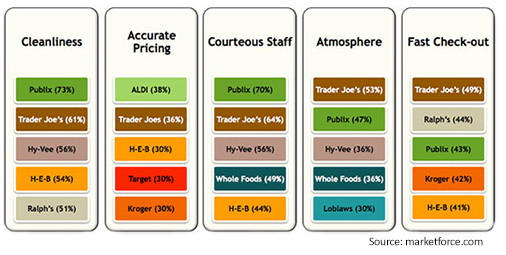
...though one has to wonder about that "Fast Check-out" ranking! They must have limited their survey to shoppers who buy groceries before noon on Mondays and Tuesdays. But seriously, folks; as I note in my book, a cheerful checkout clerk undoes the frustration of those long checkout lines. That's what this survey reflects.

My premise, that the staff is what really creates the Trader Joe's brand experience, is supported by some of the many comments that have cropped up online, in the wake of this story breaking.


And, as I note in "Build a Brand Like Trader Joe's", the way you get that superior staff interaction is by paying a little more. Increasingly, customers are aware of the implications of shopping in stores that refuse to pay a living wage...


Meanwhile, in other survey news...

It seems as if Consumers Union, the activist arm of the respected magazine Consumer Reports, timed the release of information about its own Trader Joe's survey to coincide with news about its #1 status among grocery customers generally.

Consumers Union has been working hard for the last year or two to make Trader Joe's the poster child for its campaign to reduce antibiotic use in the livestock industry. It surveyed over 1,000 Trader Joe's customers and learned that...
  • 87 percent of Trader Joe's shoppers agreed that supermarkets and meat suppliers should work together to avoid giving food animals antibiotics unless they are sick, compared to 79 percent of other store shoppers
  • Only 23 percent of Trader Joe's meat shoppers were aware that the store sells meat raised on antibiotics but 72 percent were concerned about this policy
I address the disjunction between what Trader Joe's does, and what its customers think it does in my book.

For more information on the antibiotics in TJ's meat issue, click here.


Tuesday, July 9, 2013

Chicago blogger blasts broccoli, castigates cashier for kidding with kid with kid's cart


A popular fitness blogger posted a funny rant on the Chicago Now blog, that you can read here.

The blogger, Traci D. Mitchell, is pretty astute; she's a careful reader of packaging, and was shocked to realize that her frozen broccoli had been picked & packed, and shipped frozen... from China. Regular readers of this blog--and anyone who's read my book--will know that TJ's carbon footprint is not consistent with its brand image.

I thought she was also on the money (and funny) when describing a painfully slow-but-cheerful checkout experience, involving a little kid pushing one of those cute half-size carts, accompanied by his doting mommy. That's the downside to Joe's policy--and brand strategy--of extending those employee-customer interactions. Although it works overall, when it fails, it drives customers crazy.

For what it's worth, Traci, those small carts drove me crazy when I was doing the 'cart run' out in the parking lot. They don't nest with the regular sized carts, and slow the process of returning the carts to the store. Eventually though, I realized that anything that extended the cart run was actually good for me; it gave me a welcome break from the madness of the store!

Wednesday, June 26, 2013

If this is true, it's interesting news on Trader Joe's policies re: national brands

About 85% of the branded products sold in Trader Joe's stores issold under Trader Joe's own brand(s).

Trader Joe's jealously guards the sources those products. Some of them, like yogurts made by Stonyfield, are produced by big companies that also sell their own brands in other stores (and produce other chains' private-label brands, too.) Where possible, though, TJ's likes to be the suppliers' only customer.
That said, there have always been a few exceptions on TJ's shelves, in the form of national brand products. Examples: the idiosyncratic Dr. Bronner's soaps, a few wines, and cut cheese.

I have always been bothered that TJ's sells Fiji brand bottled water, perhaps the most overpriced and evil player in the generally evil bottled water category. I'm struggling to imagine a more wasteful use of resources, than shipping water from Fiji. What's the bet that average Fijians don't have access to safe drinking water?

Another name brand product TJ's sells is Zico Coconut Water.

If this somewhat garbled post from the food blog TheDailyMeal.com is accurate, TJ's relationship with Zico is taking a new turn. Apparently, Zico's making a new flavored coconut water, that will be sold under Zico's brand, but made available exclusively through Trader Joe's.

What makes this interesting is, Zico's is not some small supplier that Trader Joe's can bully into an exclusive deal. It's owned by Coca Cola.

I don't know what to make of this news, and of course one thing we can be sure of is, Trader Joe's won't talk about it. It's possible Coke's just using Trader Joe's as a test market. It's also possible, however, that this represents a new strategy on the part of Trader Joe's, which has always relied on the sense that it's product mix -- all of the Trader Joe's-branded products -- are exclusive.

Is Trader Joe's now going to begin telling customers that it's a source of exclusive national-brand products, too?

Wednesday, June 19, 2013

Four year-old fart still funny


We all know that Trader Joe's is the singles' choice when it comes to grocery stores.

I have no way of knowing whether or not this ad, dated 2009 but which only recently surfaced on my FB page, is legitimate. All I can say is, the author's got a great sense of humor and, if he really placed this 'missed connections' ad, he's also got a hell of a sense of optimism!


Thursday, April 25, 2013

Joe's 'Net Promoter' score drops, but his ranking improves. What gives?


Satmetrix, a company that specializes in measuring customer satisfaction, just released its 2013 Net Promoter Industry Benchmarks study, and Trader Joe’s shoved the much-loved-in-the-Northeast Wegman’s chain off the top of the ‘grocery’ category list. That’s the good news, but the bad news is that while Trader Joe’s rose one position, its ‘Net Promoter’ score has actually dropped.

The Net Promoter score is based on a survey of 20,000 consumers. Each consumer ranks the brands in the survey from 1-10 based on their own arbitrary feelings of satisfaction. The number of consumers who rate a brand from 1-6 is subtracted from the number of consumers who rate it 9 or 10.

Trader Joe’s score was 63%, which suggests that for every person with mild-to-middling negative feelings about the brand, there are two people with strongly positive feelings. That was enough to put it at the top of the grocery category. The average of all grocery stores was a measly 36%, suggesting that overall negatives outweighed positives by 2:1.

Costco scored an impressive 78%, but Satmetrix classifies it as a department store.

Both Trader Joe’s and Wegman’s scores dropped in 2013; TJ’s fell by 10 points, while Wegman’s 20-point drop caused it to fall from first to fourth in the grocery sector. According to Satmetrix, an analysis of the full survey response suggests that Wegman’s relatively premium prices were at fault when customers said they would not recommend it.

Another factor in the fluctuating scores, however, are the statistical limitations of a 20,000-customer survey. That sounds like a significant sample. However, there’s ample evidence to suggest that most grocery shoppers do not travel far to buy food. Trader Joe’s has less than 400 locations, while Wegman’s operates in a strictly limited geographic area. Satmetrix’ report summary doesn’t cite the number of consumers who responded to questions about Trader Joe’s, but since TJ’s sells roughly 1% of the groceries in the U.S., the survey probably only reached a few hundred regular TJ’s shoppers, at most; with such a small effective sample size, it’s likely that the fluctuation is inside the margin of error.

Tuesday, April 16, 2013

Trader Joe's beards the lion in its den

We note that Trader Joe's, which only recently arrived in the state of Texas, has yet to open it's first Austin store, but has already announced a third Austin location. By my count, the chain will have as many stores in Austin (population <1M) as it has in the Dallas-Fort Worth area (population >6M).


The strong showing in Austin probably reflects TJ's corporate assessment of Austin's lefty-liberal skew. In the rest of Texas, they call it The People's Republic of Austin. But it's also a direct dig at Whole Foods, which is based in Austin.

The two stores are very different, of course. Whole Foods carries far more SKUs, pays vastly more attention to fresh products and national brands, in much larger stores; it's premium priced, too. But, having worked at Trader Joe's, I can tell you that a lot of people come into Trader Joe's stores and load their groceries into reusable bags carrying the Whole Foods logo.

While I'm on the subject of rival grocery chains... There are persistent rumors that Trader Joe's, or Aldi, will acquire Tesco's failed Fresh & Easy chain here in the U.S. That could make sense, I suppose. (After all, I was one of the first people to suggest it.) But a more interesting development would be for Whole Foods to use Fresh & Easy as a platform to fight Trader Joe's on it's own small-store/restricted SKU/own brand territory.

With the backing of Whole Foods, Fresh & Easy could position itself with far stronger organic/sustainable credibility, and encourage Trader Joe's customers to look closer at their favorite stores' environmental credibility.

It deserves its "Whole Paycheck" nickname, but Whole Foods kicks Trader Joe's butt when it comes to produce. The Austin-based chain also maintains far better transparency on environmental issues. That would be a point it could exploit, if it ever really wanted to aggressively go after Trader Joe's erosion of Whole Foods' customer base.

Sunday, March 31, 2013

Lawsuit labels Trader Joe's as liars

I see on the Huffington Post that Trader Joe's will have to defend itself in a class-action lawsuit over misleading labeling. Specifically, the suit refers to 'evaporated cane juice', listed as an ingredient in Trader Joe's yogurt. Evaporate cane juice, by another name, is simply sugar.

'Evaporated cane juice' = sugar. Although much commercial sugar is extracted from beets, sugar from the two sources is chemically identical. In fact, virtually all sugars are nutritionally identical. But 'evaporated cane juice' certainly sounds a lot healthier than 'high-fructose corn syrup'.
Although the U.S. Food and Drug Administration has officially banned the use of the term, but Pierce Gore* - a San Francisco-based consumer affairs attorney who has launched dozens of similar suits - claims Trader Joe's continues to use the term in a fraudulent attempt to make its prepared foods appear healthier than they really are.

I was interested to read some of the comments that appeared on Huffington's post about the suit, because they underline key points that I made in Build a Brand Like Trader Joe's -- mainly that the company's devoted fans will leap to its defense even when, as in this instance, critics have a solid case.

One poster asked, "How stupid would consumers have to be, not to realize that 'evaporated cane juice' was just another name for sugar?" Obviously, Trader Joe's doesn't think consumers do know that it's just another name for sugar; if they did, they'd just list 'sugar'.

Another pointed out that since a lot of sugar comes from beets, which are often GMO, by listing evaporated cane juice, Trader Joe's was reassuring customers of the non-GMO source of the sweetener. Leaving aside the fact that there is no genetic material in sugar, rendering GMO fears moot, that defense begs the question, why not list 'cane sugar' as the ingredient? Doing so would obviate any criticism of disingenuous labeling.

When I worked at Trader Joe's, I rolled my eyes when I saw that 'evaporated cane juice' ingredient. Notwithstanding Trader Joe's ardent defenders on HuffPo, the truth is that the company actively seeks to abet the conflation of terms like 'all natural', 'organic', and 'healthy' in its customers' minds.

Prepared foods account for the lion's share of Trader Joe's profits, and per square foot, the frozen foods section is the most profitable section of the store. And while virtually everything in there is 'all natural', and much of it is 'organic', those convenient meals are loaded with fat, calories, and especially sodium. (When I was being trained, I was warned that one question I was bound to get was, "Why is there so much salt in Trader Joe's foods?" I was told to answer that Trader Joe's never used artificial preservatives, and salt was necessary as a natural one." I was, like, Yeah but we're talking about food that's frozen.)

For those in the know, Trader Joe's spokesperson Alison Mochizuici's official statement that the company won't comment on pending litigation is kinda' funny; the company won't comment on anything, more like it. Gore, the lawyer, will either win this one or force Trader Joe's to settle and change at least one (highly) questionable labeling practice. If the management is smart, it will take this opportunity to bring both labeling and, over time, formulations of prepared foods into line with the perception people have of the brand.

*Yes, he's the Al Gore's cousin.